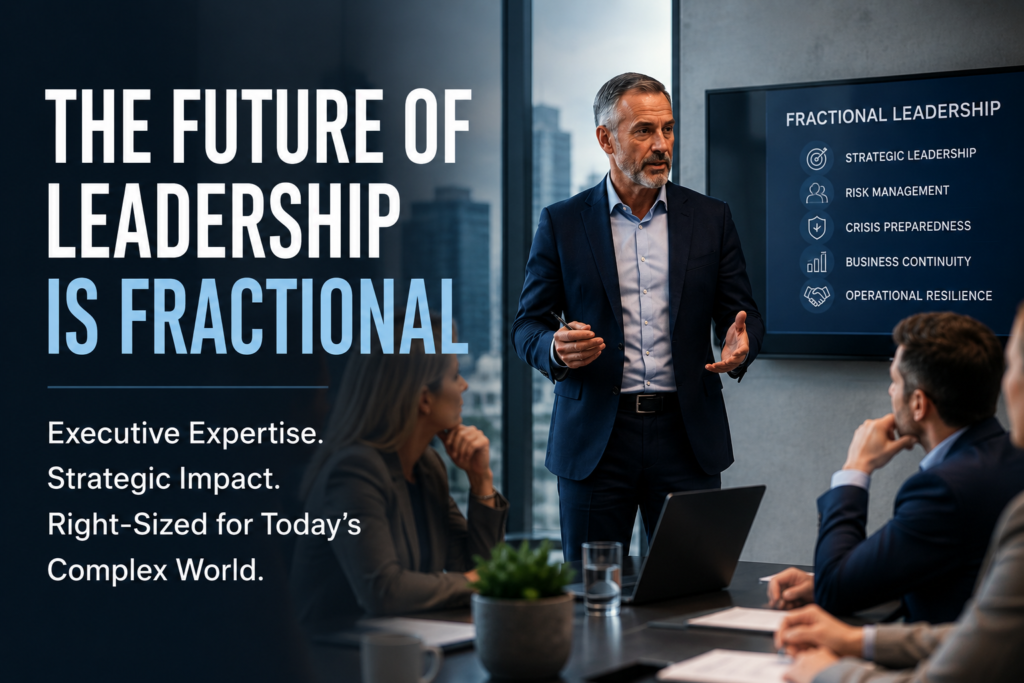
Fractional leadership executive presentation for mid-sized companies
Why modern companies are rethinking executive leadership in an increasingly complex world
For decades, businesses followed a predictable leadership model.
As organizations grew, they added more full-time executives:
- Chief Operating Officers
- Chief Financial Officers
- Chief Information Officers
- Chief Security Officers
- Human Resources executives
- Risk and compliance leaders
The assumption was simple:
If a company faced complex challenges, it needed more permanent executive leadership.
But the business world has changed dramatically.
Today, organizations are operating in an environment defined by:
- Rapid technological disruption
- Economic uncertainty
- Cybersecurity threats
- Supply chain instability
- Workplace violence concerns
- Brand and reputational risk
- Regulatory complexity
- Talent shortages
- Increased operational pressure
At the same time, companies are under enormous pressure to remain lean, agile, and financially disciplined.
This has created a major shift in how leadership itself is delivered.
The future of leadership is increasingly fractional.
What Is Fractional Leadership?
Fractional leadership allows companies to access experienced executive-level expertise on a part-time, project-based, advisory, or retained basis.
Instead of hiring a full-time executive, organizations engage seasoned leaders when they need strategic guidance, operational maturity, and specialized expertise.
Examples include:
- Fractional Chief Security Officers (CSO)
- Fractional Chief Risk Officers
- Fractional Chief Operating Officers
- Fractional Crisis Management Advisors
- Fractional Business Continuity Leaders
- Fractional HR or Compliance Executives
This model gives organizations access to high-level experience without the cost and commitment of a full-time executive structure.
Why Companies Are Moving Toward Fractional Leadership
1. Enterprise-Level Risks Now Affect Everyone
Many mid-sized organizations now face the same threats once associated only with large corporations.
A cyberattack, workplace incident, supply chain disruption, or reputational crisis can impact a 300-person company just as severely as a multinational organization.
The difference is that mid-sized companies often lack:
- Dedicated risk leadership
- Crisis management expertise
- Security strategy
- Business continuity planning
- Executive preparedness structures
Fractional leadership helps bridge that gap quickly and effectively.
2. Companies Need Agility
Traditional executive hiring can take months.
Business risks do not wait.
Fractional leaders can often step in immediately to:
- Assess vulnerabilities
- Improve governance
- Build operational frameworks
- Strengthen crisis readiness
- Mentor internal teams
- Lead strategic initiatives
Organizations gain immediate access to experience without lengthy recruitment cycles.
3. Executive Expertise Is Expensive
Hiring senior executives involves:
- Salary
- Benefits
- Bonuses
- Recruiting fees
- Long-term commitments
- Organizational overhead
For many organizations, especially growing companies, a full-time executive role may not be financially practical.
Fractional leadership provides flexibility while still delivering strategic value.
4. Outside Perspective Matters
Internal teams can become too close to operational blind spots.
Experienced outside leaders bring:
- Fresh perspective
- Cross-industry experience
- Independent assessment
- Strategic objectivity
- Proven operational insight
Sometimes the most valuable thing an organization gains is clarity.
Fractional Leadership Is About Outcomes — Not Titles
One of the biggest misconceptions about leadership is that effectiveness is tied to presence.
It is not.
Strong leadership is measured by:
- Decision-making
- Strategic direction
- Preparedness
- Accountability
- Risk reduction
- Operational maturity
- Organizational confidence
Many companies do not need another executive sitting in meetings full-time.
What they need is the right expertise at the right level during the moments that matter most.
The Security and Risk Landscape Is Changing
In the areas of security, crisis management, and organizational resilience, the need for experienced leadership has never been greater.
Organizations today must think beyond traditional security models.
Modern executive leadership now includes:
- Crisis management planning
- Workplace violence prevention
- Travel security
- Supply chain resilience
- Business continuity
- Emergency preparedness
- Vendor oversight
- Executive risk management
- Reputation protection
The organizations that prepare early are often the ones that recover fastest.
As the saying goes:
In crisis, organizations rarely rise to the occasion. They fall to the level of their preparation.
Fractional Leadership Is Becoming a Competitive Advantage
The most adaptable organizations are no longer asking:
“Do we need a full-time executive?”
Instead, they are asking:
“What expertise do we need to succeed right now?”
That shift matters.
Companies embracing fractional leadership are often:
- More agile
- More cost-effective
- Better prepared
- Faster to adapt
- More resilient during disruption
This is not a temporary business trend.
It is an evolution in how modern organizations access leadership itself.
Final Thoughts
Leadership is changing.
The traditional model of building large permanent executive structures is being replaced by more flexible, scalable, and strategic approaches.
Fractional leadership allows organizations to access real-world executive experience without unnecessary overhead while still improving preparedness, governance, and operational resilience.
For many companies, especially mid-sized organizations, it may become one of the smartest strategic decisions they make.
The future of leadership is not necessarily full-time.
The future of leadership is fractional.
Frank Elsner
Founder, Stonehaven Risk Group
Executive Security Advisor | Crisis Management | Business Continuity | Security Leadership